Introduction: The WSC Debate Format
World Scholar's Cup Team Debate is a 3-on-3 format where teams compete on motions drawn from the curriculum. Unlike many debate formats, WSC debate emphasizes interdisciplinary thinking, collaboration, and connection to the year's theme.
Format Overview
Speech Times
- Six speeches per debate, alternating sides
- Every speaker: up to 4 minutes
- No interruptions - speeches run uninterrupted
Key Features
- Three debates per tournament, win or lose
- 15 minutes of prep time - no devices
- Position (Pro/Con) assigned, not chosen
The Secret to WSC Debate Success
The teams that win at Global Rounds aren't necessarily the loudest or fastest. They're the ones who connect ideas across the curriculum, structure arguments clearly, and engage thoughtfully with their opponents. These five strategies will help you do exactly that.
The AREA Framework for Arguments
Structure every argument for maximum impact
The strongest arguments follow a clear structure that judges can easily follow and remember. The AREA framework ensures you never leave an argument half-built.
The AREA Framework
Example in Practice
Motion: "This house believes that technological progress has done more harm than good."
Pro argument: Technology has amplified inequality (Assertion). While productivity has increased, the benefits have concentrated among those who own technology rather than those who work with it (Reasoning). From 1979 to 2020, productivity grew 60% but median wages only grew 16%, with most gains going to top earners according to the Economic Policy Institute (Evidence). This shows that technological "progress" has created a world where working harder doesn't mean living better - which is harm, not good (Analysis).
Cross-Curricular Connections
Use all six subjects to build stronger cases
WSC debate rewards scholars who can draw on knowledge from across the curriculum. Using examples from multiple subjects shows depth of understanding and makes your arguments more persuasive.
Literature
Character arcs and narrative outcomes as case studies
History
Real-world precedents and their consequences
Science
Data, research findings, and technological realities
Social Studies
Economic systems, political outcomes, social patterns
Arts
Cultural expression and societal values
Special Area
Theme connections that tie everything together
Pro Tips
- Prepare 2-3 examples from each curriculum subject that can be framed multiple ways
- Link Science facts to Social Studies implications, or Literature themes to History examples
- Use the Special Area theme ("Are We There Yet?") to tie diverse examples together
- Practice quickly adapting familiar examples to unexpected motions
Strategic Note-Taking
Control the debate without interruptions
WSC debate has no Points of Information: every speech is delivered uninterrupted. That makes your notes the only lever you hold while opponents speak - and the teams that track the debate most precisely usually win it.
What to Track
- When opponents make a claim without evidence - flag it for your next speaker to challenge
- When you spot a logical flaw - record their exact wording so the rebuttal lands
- When opponents ignore a key stakeholder - plan to force the issue in your next speech
- When they drop one of your arguments - highlight every dropped point in your final speech
How to Keep the Flow
- 1Split the page into two columns: their arguments, your responses
- 2Capture key phrases verbatim - quoting opponents precisely is devastating
- 3Mark each opposing argument: answered, partly answered, or dropped
- 4Hand targeted notes to your next speaker before they stand up
Additional Tips
- Assign each teammate specific opposing speakers to track
- Note concessions - opponents often give ground without realizing it
- Use the post-debate feedback exchange: patterns across your three rounds are gold
- Track arguments, not sentences - transcribing everything means analyzing nothing
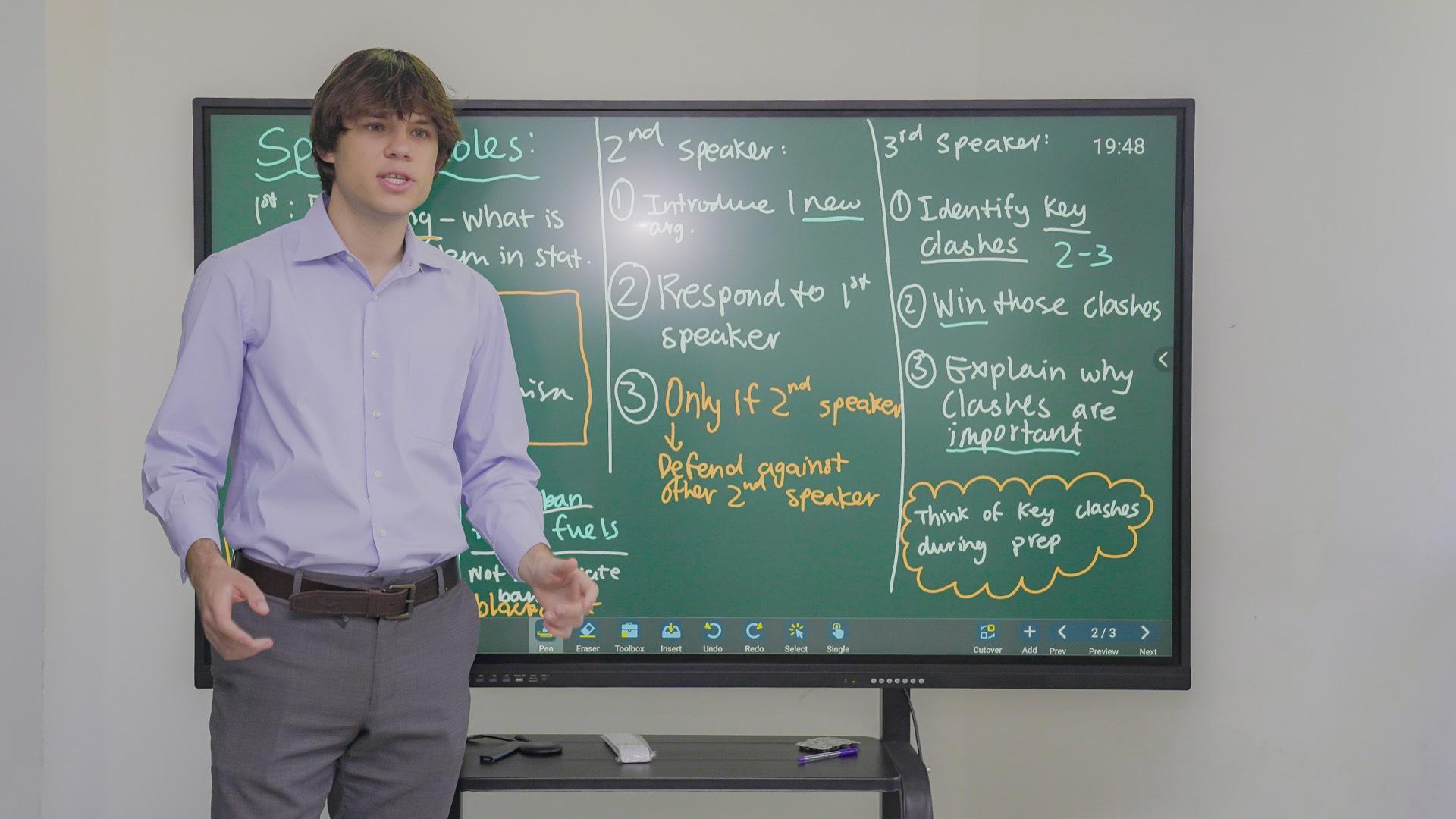
Team Role Optimization
Play to each speaker's strengths
Each speaker in the team has a distinct role. Understanding and optimizing these roles ensures your team operates as a cohesive unit rather than three individuals.
First Speaker
- Define the motion clearly (especially important on Proposition)
- Set up the team line - the overarching argument
- Present 1-2 strong substantive arguments
- Establish the tone and confidence for your team
Ideal for: Clear communicator who thinks quickly and handles pressure well
Second Speaker
- Rebuild and extend arguments from First Speaker
- Deliver the most substantive material
- Engage in clash - directly refute opponent arguments
- Bridge between setup and summary
Ideal for: Deep curriculum knowledge and strong analytical skills
Third Speaker (Reply)
- Summarize the debate from your side's perspective
- Identify the key clashes and explain why you won them
- NO new arguments - synthesis only
- Leave the strongest final impression
Ideal for: Big-picture thinker who can synthesize on the fly
Rebuttal Excellence
Win by directly defeating opponent arguments
Debates are won not just by building strong arguments but by dismantling your opponents'. Effective rebuttal shows judges you're engaging with the actual debate, not just delivering prepared speeches.
Direct Contradiction
Challenge the factual accuracy of their claims with counter-evidence
"They claim renewable energy can't meet demand, but Denmark generated 80% of electricity from wind in 2023"
Logical Flaw
Expose gaps in their reasoning chain
"They assume correlation equals causation - just because X followed Y doesn't mean Y caused X"
Impact Calculus
Argue their impacts are less significant than yours
"Even if their benefit exists, it affects far fewer people than the harm we've identified"
Counter-Example
Provide a case that disproves their general claim
"They say democracies are always stable, but Weimar Germany shows otherwise"
Mechanism Failure
Show why their proposed solution won't actually work
"Their plan relies on perfect information, but markets consistently show information asymmetry"
Motion Analysis Techniques
Before you can debate effectively, you must understand what the motion is asking. Different motion types require different approaches.
Value Motions
This House Believes That (THBT)Argue about whether something is good or bad, right or wrong
Example: THBT technological progress has done more harm than good
Approach: Define your value framework (what counts as "harm"? "good"?), then argue within it
Key Question: What principles should guide our evaluation?
Policy Motions
This House Would (THW)Argue about whether a specific action should be taken
Example: THW ban social media for children under 16
Approach: Discuss the mechanism (how would it work?), likely effects, and whether it achieves its goals
Key Question: Will this policy achieve its goals, and are those goals worth achieving?
Comparison Motions
This House Prefers / Would RatherArgue which of two options is better
Example: TH, as a developing nation, would prioritize economic growth over environmental protection
Approach: Define criteria for comparison, then show why one option scores better on those criteria
Key Question: What matters most in making this choice?
Actor Motions
This House, as [Actor], WouldArgue what a specific actor should do
Example: TH, as a parent, would prioritize academic achievement over artistic development
Approach: Consider the actor's interests, constraints, and responsibilities
Key Question: What would a reasonable [actor] prioritize, and why?
Advanced Motion Analysis
When you receive a motion, immediately ask these questions:
- What words need defining? - Ambiguous terms should be defined by Proposition in a reasonable way
- What's the status quo? - What happens if we don't change anything?
- Who are the stakeholders? - Who is affected by this motion?
- What's the core tension? - What fundamental values or interests are in conflict?
Maximizing Prep Time
With only 15 minutes of prep time - and no devices - efficiency is critical. Here's a structured approach to make the most of every minute.
Motion Analysis
0-3 min- Identify motion type (value, policy, comparison)
- Define key terms together
- Identify the core clash
- Determine if you're Pro or Con
Case Building
3-8 min- Brainstorm arguments (aim for 5-6)
- Select best 3-4 arguments
- Assign arguments to speakers
- Identify strongest opposition arguments
Argument Development
8-12 min- Each speaker develops their assigned arguments
- Apply AREA framework to each argument
- Find curriculum examples to support points
- Anticipate rebuttals
Team Coordination
12-15 min- Brief each other on key points
- Predict opponents' strongest arguments and plan responses
- Agree on definitions and team line
- Review speaking order and timing
DO During Prep
- Write bullet points, not full sentences
- Discuss as a team the first 5 minutes
- Split up to develop individual arguments
- Brief each other before time is up
DON'T During Prep
- Write full speeches word-for-word
- Argue with teammates about strategy
- Focus only on your own arguments
- Ignore what opposition might say
Advanced Techniques
The Principle-Mechanism Split
Separate your argument into "why this is good in principle" and "why the mechanism will work"
On a policy motion: First, argue that the goal (helping climate refugees) is morally required. Then separately argue that your mechanism (mandatory quotas) will achieve it. Opponents must defeat BOTH levels.
Benefit: Makes your argument harder to attack, as opponents must address both levels
Stakeholder Analysis
Identify all groups affected by the motion and analyze impacts on each
For a motion on education policy: How does it affect students, teachers, parents, employers, and society? Don't just argue abstract benefits; show concrete impacts on real groups.
Benefit: Shows judges you're thinking comprehensively; catches arguments opponents miss
Counter-Modeling
Don't just oppose; propose a better alternative that achieves similar goals
Instead of just saying "mandatory climate refugee quotas won't work," argue for a better alternative: "voluntary regional agreements with financial incentives work better because..."
Benefit: Shifts the debate from your mechanism's flaws to a comparison of mechanisms
The Comparative Close
In your team's final speech, explicitly compare the competing visions of each side
"At the end of this debate, you've seen two worlds: one where... and one where... We believe judges should prefer our world because..."
Benefit: Gives judges a clear framework for decision; makes voting for you easier
Burden Setting
Early in the debate, establish what each side must prove to win
"To win this debate, the opposition must show not just that our policy has costs, but that those costs outweigh the benefits we've demonstrated. We've shown..."
Benefit: Frames the debate in terms favorable to your side; puts pressure on opponents
Common Mistakes to Avoid
✕Reading from notes too much
✓Use bullet points, not scripts. Make eye contact with judges.
✕Introducing new arguments in the final speech
✓The last speech is for synthesis and comparison. All substantive content must come earlier.
✕Ignoring opponent arguments
✓Always engage with at least 2-3 of their key points directly.
✕Speaking too fast
✓Clarity beats quantity. Judges can't score what they can't follow.
✕Weak team coordination
✓Brief between speeches. Know what each person will cover.
✕Generic examples only
✓Use specific curriculum knowledge to stand out from other teams.
Practice Drills for Your Team
Consistent practice is what separates good teams from great ones. Here are drills you can run with your team to sharpen each aspect of your debate skills.
5-Minute Case Building
Given a motion, build a complete case with 3 arguments in 5 minutes. Practice both Pro and Con.
Flow and Rebut
One person speaks for 2 minutes on any topic. Others take two-column notes, then deliver a 60-second rebuttal built only from those notes.
Rebuttal Training
Watch a video of a debate argument. Pause and deliver a 60-second rebuttal. Compare to what the actual opponent said.
Cross-Curricular Linking
Pick a random motion and find one relevant example from each of the 6 WSC subjects in 3 minutes.
Full Practice Debates
Run complete debates with another team or coaches. Debrief immediately after.
Sample Motions with Analysis
Study these fully-analyzed motions to understand how top teams build cases. Practice developing your own cases for each before reading our analysis — then keep drilling with the 24-motion practice bank.
THBT the rise of AI will lead to a net decrease in human happiness
Analysis: This is a value motion about AI's impact on wellbeing
Proposition Arguments:
Argument 1: Job Displacement and Purpose
AI automation will eliminate meaningful work, and work is central to human identity and purpose. Without meaningful work, people experience depression and loss of self-worth.
Curriculum links: Science & Technology (AI), Social Studies (labor economics), Special Area (progress)
Argument 2: Social Comparison Amplification
AI-powered social media optimizes for engagement through comparison, which psychological research shows reduces happiness. More sophisticated AI means more effective manipulation.
Curriculum links: Science (psychology), Social Studies (social media), Literature (dystopian themes)
Argument 3: Erosion of Human Connection
As AI companions become more sophisticated, people may prefer predictable AI relationships to complex human ones, leading to isolation.
Curriculum links: Special Area (journey vs destination), Social Studies (community)
Anticipated Opposition Arguments:
- AI will free humans from drudgery, enabling more fulfilling pursuits
- AI can solve problems (disease, climate) that cause massive suffering
- Historical pattern: technology fears are overblown (industrialization, internet)
THW require all nations to accept climate refugees
Analysis: This is a policy motion about international refugee obligations
Opposition Arguments:
Argument 1: Impracticality of Enforcement
No international body can force sovereign nations to accept refugees. Unenforceable mandates undermine international law and create resentment.
Curriculum links: Social Studies (international relations), History (UN limitations)
Argument 2: Resource Strain Backlash
Rapid forced immigration causes host country backlash, rising nationalism, and ultimately worse outcomes for refugees. Gradual, voluntary integration works better.
Curriculum links: Social Studies (migration), History (immigration policy), Science (climate projections)
Argument 3: Misplaced Focus
Resources spent on forced relocation would be better invested in climate mitigation and adaptation in vulnerable regions, keeping people in their homes.
Curriculum links: Science (climate solutions), Social Studies (development economics)
Anticipated Opposition Arguments:
- Wealthy nations caused climate change and bear moral responsibility
- Climate refugees will exist regardless; denial doesn't prevent movement
- Historical success of refugee integration (post-WWII Europe)
Practice Exercise
For each sample motion above:
- 1Build a case for the opposite side before reading our analysis
- 2Write rebuttals to each of our arguments
- 3Find additional curriculum connections we didn't mention
- 4Practice delivering one argument with the AREA framework
Final Thoughts
WSC debate is a unique format that rewards preparation, teamwork, and the ability to think on your feet. The five strategies in this guide - AREA arguments, cross-curricular connections, strategic note-taking, optimized team roles, and effective rebuttal - form the foundation of winning debate performance.
Remember: the best debaters aren't those who memorize the most facts or speak the fastest. They're the ones who can connect ideas, adapt to any motion, and work seamlessly with their teammates. Practice these strategies, and you'll be ready to compete at the highest levels.